It's probably not fitness
For most triathletes, swimming is the most humbling of the three sports. You can be fit enough to ride for five hours and still climb out of the water gassed after 1,900 metres. The water doesn't lie: it shows every inefficiency, punishes poor form and rewards patience.
And if you're thinking "it's the shortest leg, why bother", remember this: it's the one the race starts with. Come out of the water tired from a stroke you can't hold, and it will hurt your bike and your run in ways you won't see coming.
The good news is that swimming is one of the most trainable skills in triathlon. When a triathlete's swim stops improving, it's rarely a fitness problem. It's almost always how often they swim, and how they structure the time they do spend in the pool.
The #1 reason: lack of consistency
Skip the pool for a week or two and you lose your touch. Your feel for the water fades faster than your fitness does.
Adult-onset swimmers feel it most. A few missed weeks and it feels like starting over.
Seasoned swimmers lose less, but they still go backwards a little every time.
The other habits that keep triathletes stuck, usually all at once:
Swimming once a week. Better than nothing, but not enough to see real progress.
The same workout every time. The same 2,000 m, every session, feels productive. Without variety, your gains plateau. You wouldn't ride the same Zone 2 loop every day; don't swim that way either.
No rest built into the sets. Rest inside a workout is part of how you adapt, not lost time.
Skipping the warm-up. Your nervous system isn't ready, so the main set is worse.
Toys as crutches. Fins, buoys and paddles have a role, but if you can't swim well without them, they're hiding the problem (more on that below).
How often should you swim?
Three times a week is the golden standard for age-groupers. Not because more wouldn't help, but because you also have to bike, run, lift, eat, work, and live. Every extra swim has to fit around your key bike and run sessions and still leave room to recover.
Only swimming twice a week? Then placement is everything. The goal is to shrink the gap between sessions. Two swims back-to-back leave you five days without touching the water; spread them out so you're never more than three days off.
Can you get to three? Then two days in a row becomes a great tool: day one brings back your feel for the water, and day two rides that confidence and body memory. But it only works when there's a third swim later in the week.
Four or five times a week? Great if you can, but not at the expense of progressing as a triathlete. Use it in blocks, the way a cycling camp builds volume for a set period: 3 or 4 weeks of 4–5 swims can carry you over a plateau. Expect more work outside the water too. Bodies that aren't used to the volume can pick up niggles like sore shoulders, so dryland warm-ups, mobility and strength work matter even more.
The sustainability test
The best plan is the one you can keep doing. Ask yourself: could I do this for weeks and weeks? If you finish a week of three swims and think "hey, I could fit in another session", that's perfect. But don't. A bit of holding back beats burning out.
What it looks like in a week
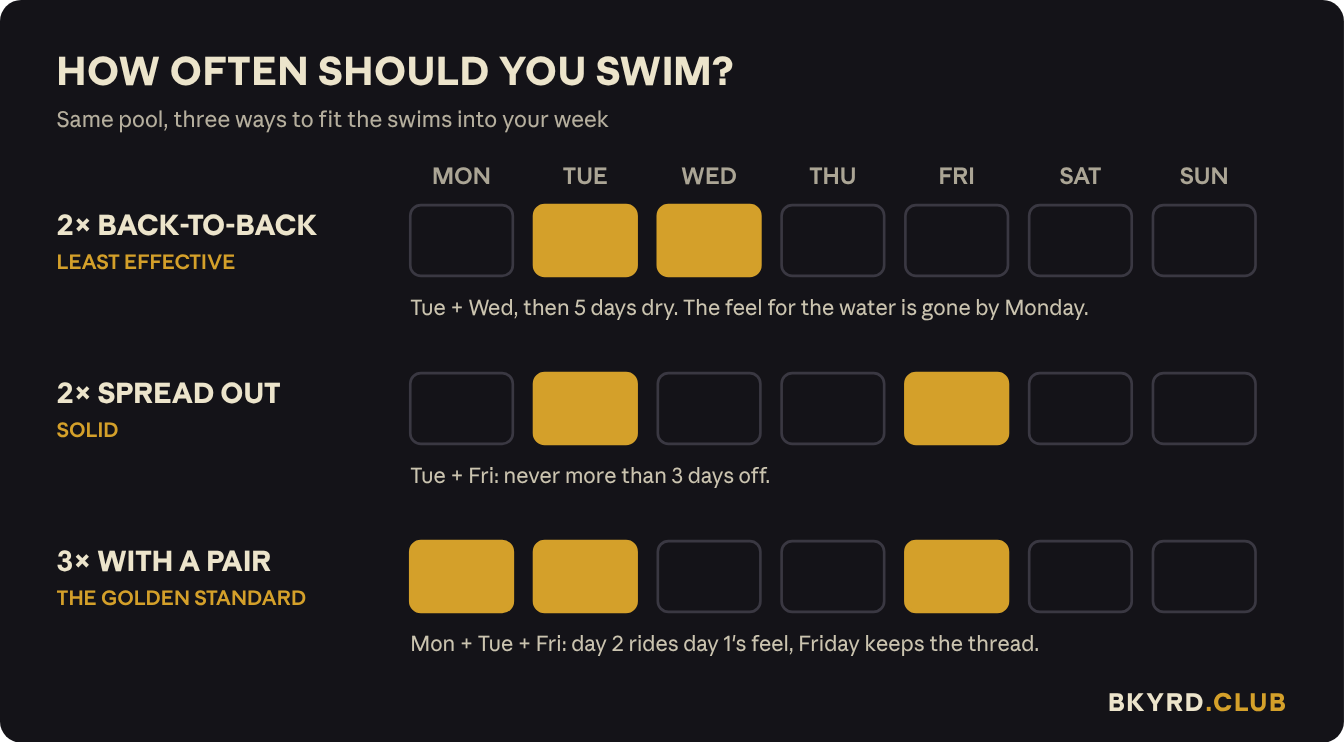
Two swims back to back look productive, but they leave five dry days behind them. The same two swims spread out keep the gap to three days, and a third swim paired with one of them is where progress really starts: the second day builds on the first day's feel for the water.
The four sessions every triathlete needs
Swimming is like running and cycling… ish. You need technique, aerobic capacity, top-end speed and resilience. The catch is that swimming demands far more technique: you can muscle through a 10 km run with poor form, but not through the water. A good week rotates through four kinds of session.
1. Easy: feel for the water
Easy swims are not junk metres. They reinforce good form while you're fresh and help you recover between harder sessions. Treat them as technical tune-ups:
Catch and pull drills to refine how your hand enters and anchors in the water.
Breathing practice, bilateral and under pressure.
Kick sets for propulsion and body position.
Swimming easy with intention is a skill. Most triathletes go too fast on these days and miss what slowing down and feeling the water teaches.
2. Tempo: endurance and confidence
Moderately hard but sustainable. This is where you build the triathlon-specific endurance to hold a pace without falling apart, and where gains compound: not by sprinting faster, but by swimming long with control.
4 × 500 m at 7/10 effort, 30 s rest
Broken 1,000s, like 4 × 250 m with only 10–20 s rest
Keep your splits even, your breathing smooth and your technique stable as fatigue creeps in.
3. Speed: your top gear
Short, fast efforts teach your nervous system to recruit muscle more efficiently and give you gears to use in a race: a hard start, catching a draft, passing someone, a strong finish before T1.
12–16 × 50 m near max effort, 20 s to 1 min rest depending on level
4 rounds of 8 × 25 m all out, 10 s rest, 60 s between rounds
Form comes first. Sprinting with sloppy technique only reinforces bad habits, so film yourself or have a lane buddy watch.
4. Pace variation: real open water
Open water racing is anything but steady: hard to the first buoy, settle into a draft, surge again near the end. Train for that chaos.
3 rounds continuous: 200 m fast, 100 m easy, 50 m faster, 50 m easiest
3 × (300 m moderate, 100 m hard, 50 m easy)
The skill here is awareness: how each effort feels, how your body position changes with speed, and how to shift gears without your technique falling apart.
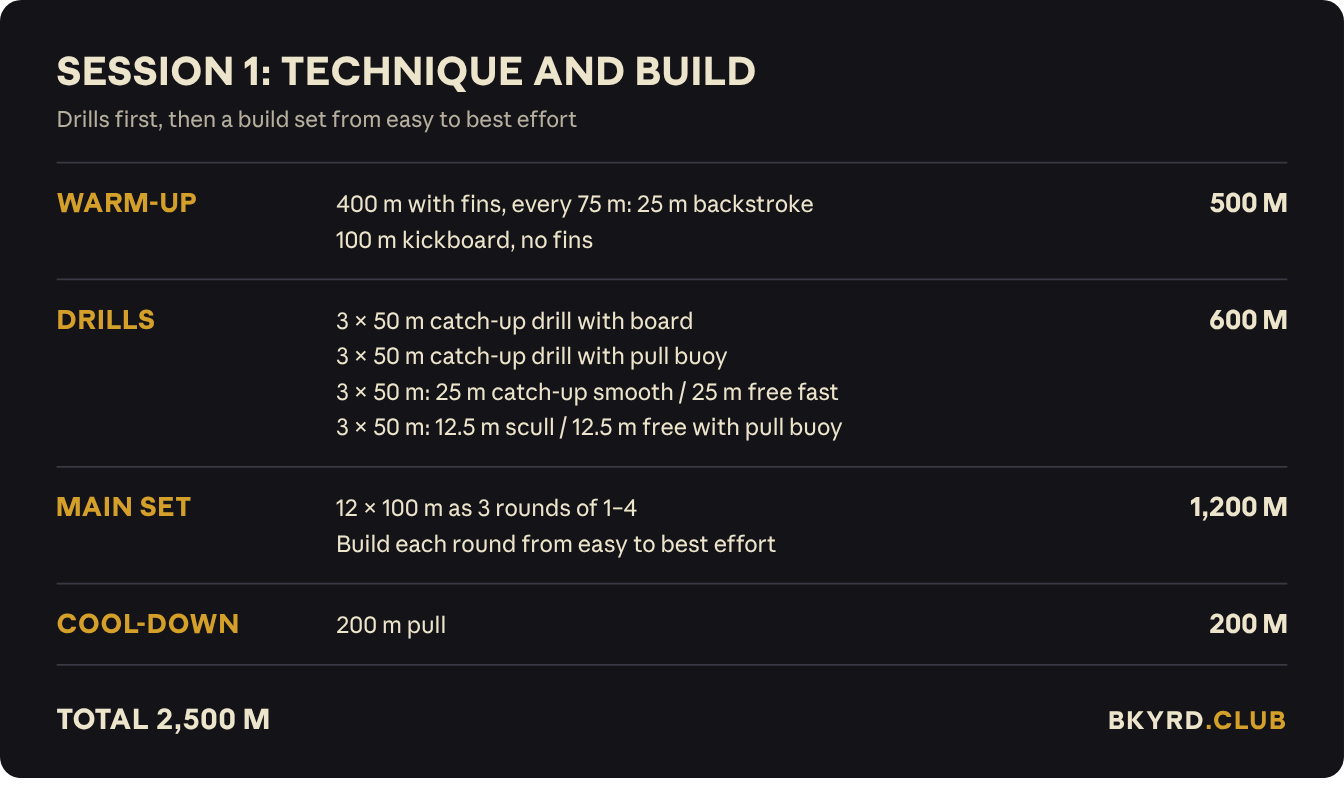
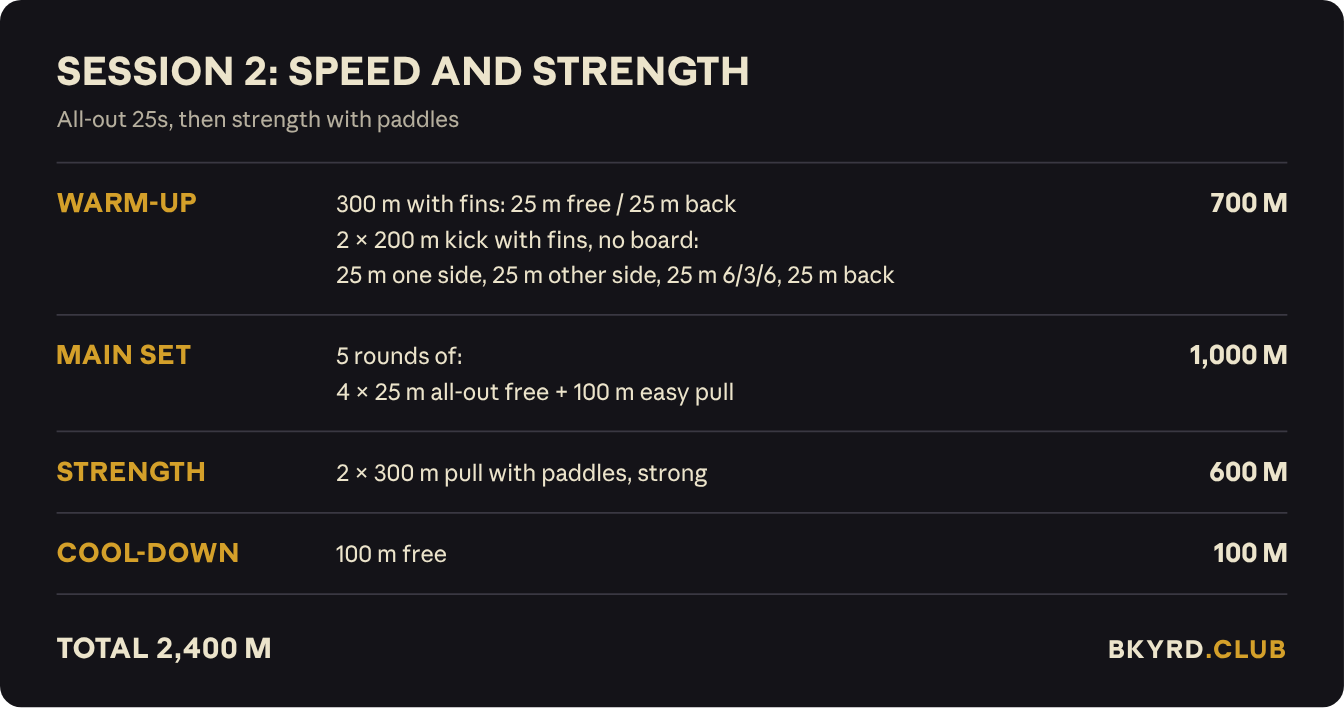
Two sessions we like
Toys: tools, not crutches
Use them to build something, not to hide what's missing.
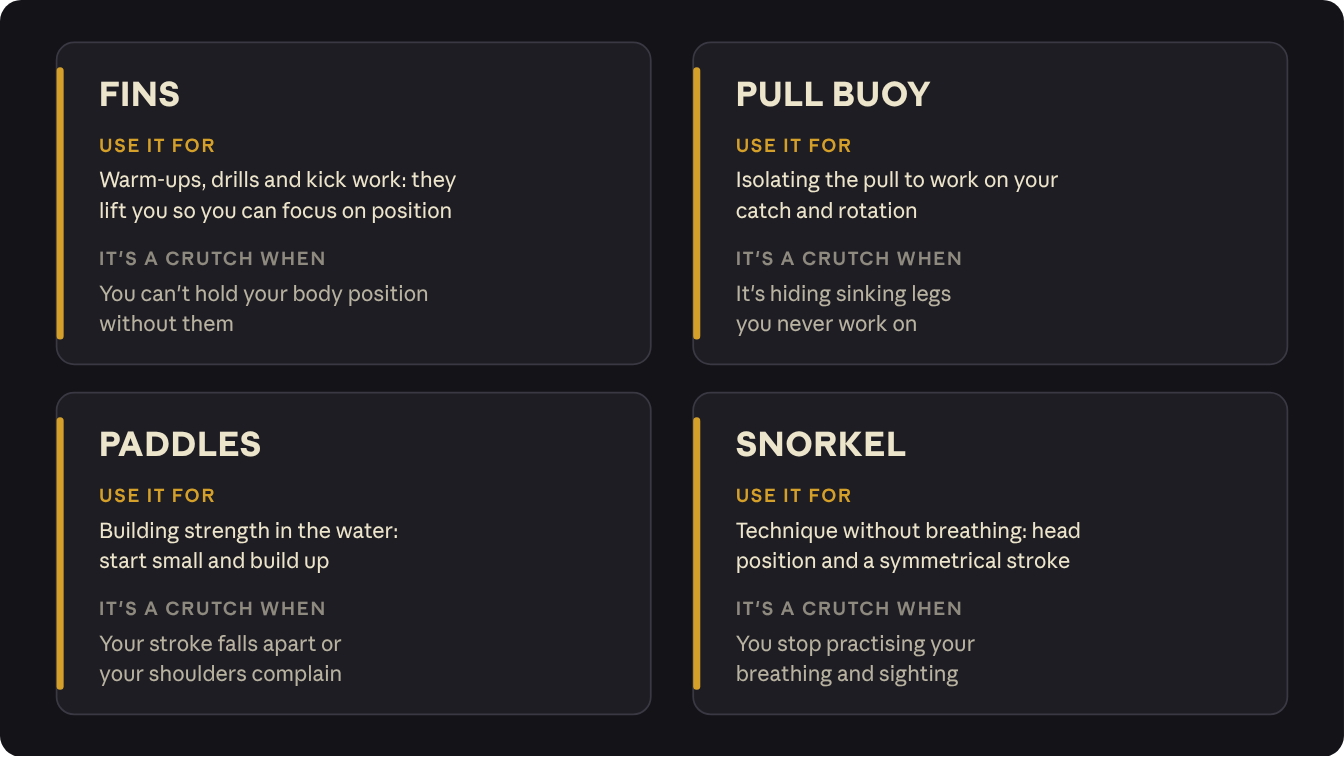
Before you get in: pre-swim activation
A few minutes on land improves your rotation in the water, and the session's quality with it:
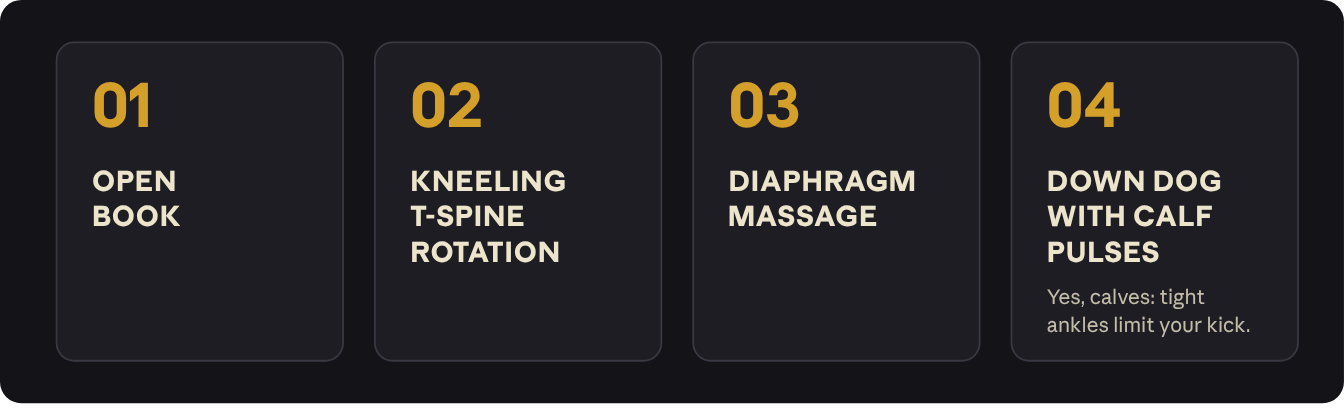
More intention before the swim means more benefit from it.
You've got to swim
There is no shortcut. No swim erg, dryland routine or YouTube drill replaces time in the water. Swimming trains things nothing else can:
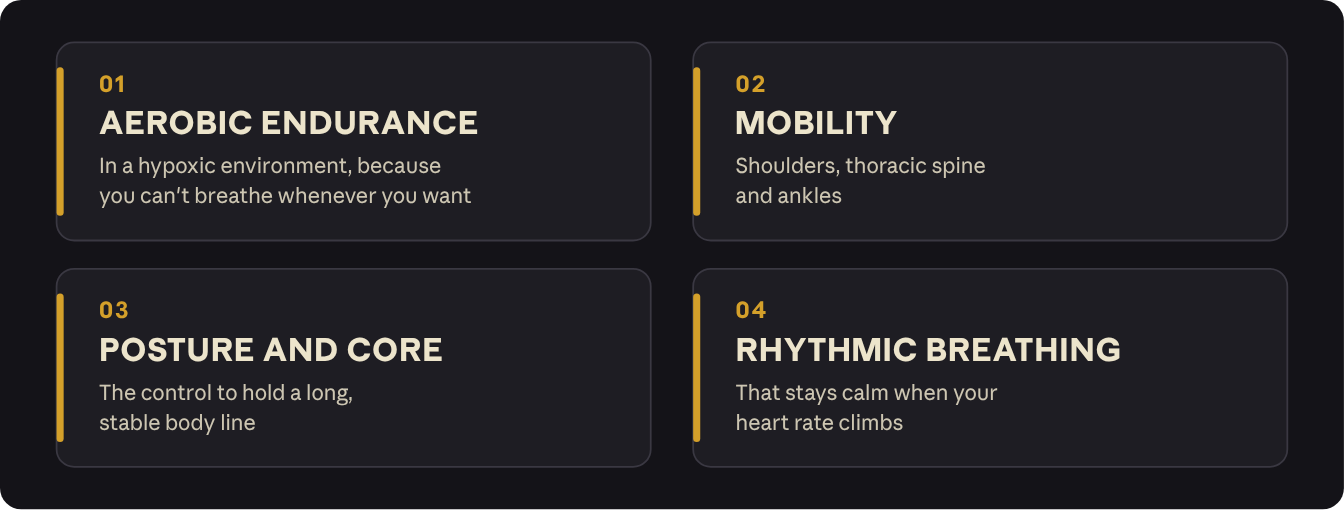
Respect the process. Show up regularly, swim each session with a purpose, and the speed follows. Effort is a choice.
Start here: next step with BKYRD
Pick a frequency you can hold for the next eight weeks, slot in the four session types, and time a steady 400 m at the start and end of the block to see what moved.
Want a plan built around your week, your pool times and your race? That's what our Online Coaching is for. Book a free discovery call and we'll look at where your swim is today and what it needs next.