Strength works. Most runners just do it wrong.
Two solid strength sessions a week, built on a few heavy lifts and followed block by block, will make you a more economical and more durable runner. That isn't gym-bro opinion; it's one of the best-supported findings in endurance research.
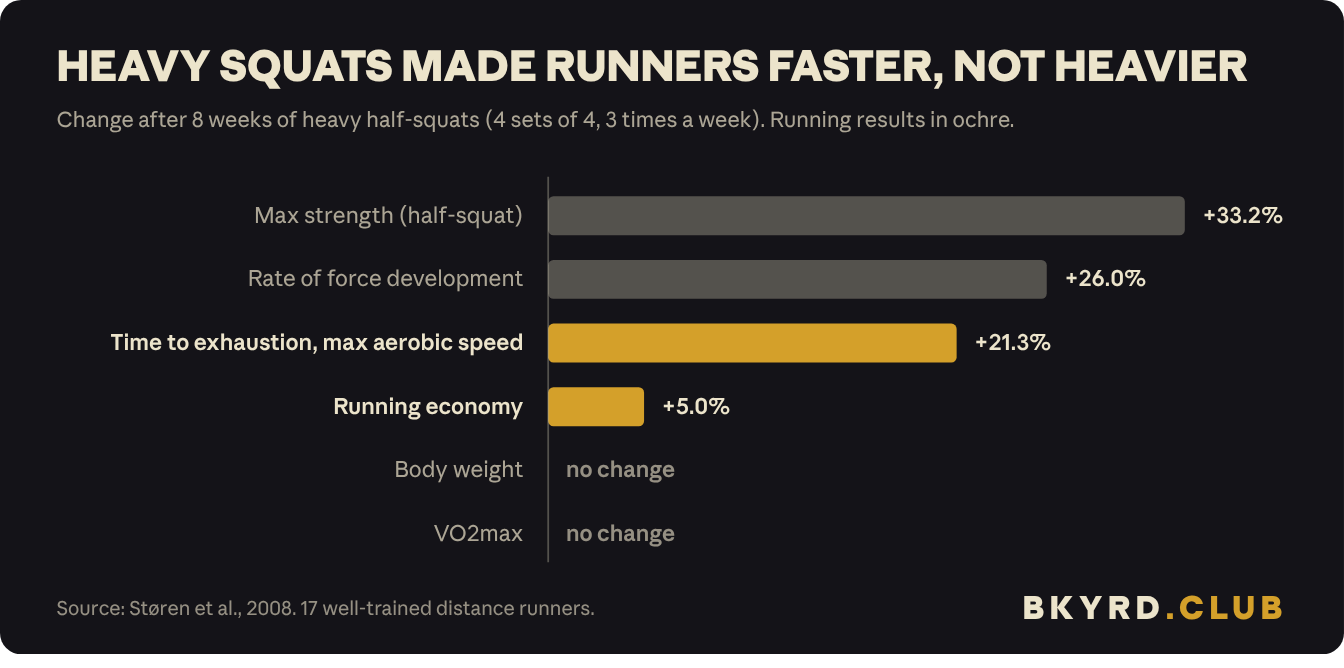
In a classic study, well-trained distance runners added heavy half-squats (4 sets of 4 reps) three times a week for 8 weeks. Their running economy improved by 5%, they could run 21% longer at maximal aerobic speed, and their body weight didn't change at all [1]. A 2024 meta-analysis of 38 studies and 894 runners found the same pattern: heavy loads improved running economy, while lighter loads didn't reach a significant effect [2].
The injury case is just as strong. Across randomized trials in sport, strength training cut injuries to roughly a third of what they were in athletes who didn't do it [3].
So why do so many runners lift for months and feel nothing? In my coaching, it almost always comes down to two mistakes and one myth.
Mistake 1: too many exercises
The most common runner program I see is a long list: ten or twelve exercises, a few sets each, a bit of everything. It feels thorough. It doesn't work.
Strength comes from doing a few movements often enough, and heavy enough, that your body has to adapt. Spread the same 45 minutes across twelve exercises and each one gets too little work to change anything. You also never get good at any of them, so you can't load them safely, and the program stalls at "light and tiring".
A runner's session needs far less than most people think:
One main lift, done heavy: usually a deadlift variation. I really like the trap-bar deadlift, and next to that the deadlift from blocks, starting from a dead stop.
One or two accessory lifts in the same session: a single-leg exercise like a split squat variation, alternated with a knee flexion exercise like a leg curl.
Two to three remedial exercises to finish: calf work, trunk stability and glutes.
That's about six exercises. Done well, block after block, they will do more than an overloaded program ever will.
Mistake 2: rushing the progression
The second mistake is impatience. A block is written to build week by week, and runners want to skip straight to the hardest week: the heaviest weight, the final rep scheme, on day one.
There's a reason the early weeks look easy. They teach the movement, so the heavy weeks are done with good form. They let tendons and connective tissue catch up, because those adapt more slowly than muscle. And they leave room to recover, so your running doesn't suffer while you get stronger.
Jump ahead and one of three things happens: your form breaks down under load, your legs are too sore to run your key sessions, or a niggle turns into an injury. All three end the same way: the strength work gets dropped.
The rule is simple. Keep some in the tank and build as you go: the last week of a block should be the week with the highest total load. If a week feels easy, good: that's the plan working, not a sign to add more.
The myth: light weights are enough
Light weights for lots of reps feel like "runner strength". But your legs already do thousands of light repetitions every run. Another 3 sets of 20 with a small dumbbell asks nothing new of them.
What runners lack is force: the ability to push into the ground harder and faster on each stride. That's built with loads heavy enough that you can only do a few good reps. In the 2024 meta-analysis, heavy loads (80% of your max or more) significantly improved running economy, while moderate loads and plyometrics alone did not reach a significant effect [2].
"Heavy" scares a lot of runners, so two things to know:
Heavy won't make you bulky. Low reps with full rest build strength mainly through your nervous system and stiffer, springier tendons, not size [4], and your running volume works against muscle growth anyway. In the Støren study, runners got 33% stronger with no change in body weight.
Heavy is earned, not day one. You build up to it over a block, with technique first. That's exactly why Mistake 2 matters.
Why deadlift variations come first
If I could give a runner only one movement, it would be a deadlift variation. It's also the movement I correct most often.
The deadlift trains the hinge: bending at the hips with a long, braced spine, then driving them forward. That's the job of your glutes and hamstrings, the muscles that push you forward on every stride and hold your pelvis steady when you're tired late in a race. Runners who can't hinge well tend to lean on their quads, calves and lower back instead.
The variations I use most with runners:
Trap-bar deadlift: my favourite for runners, and the easiest way to load heavy safely.
Deadlift from blocks: each rep starts from a dead stop, so you have to create force from nothing, with no bounce to help.
Romanian deadlift (RDL): the best teacher of the hinge, from the hips down to mid-shin.
Single-leg RDL: the same pattern on one leg, which is how you actually run.
Kettlebell deadlift: a starting point for anyone new to lifting.
The faults I see most, and what fixes them:
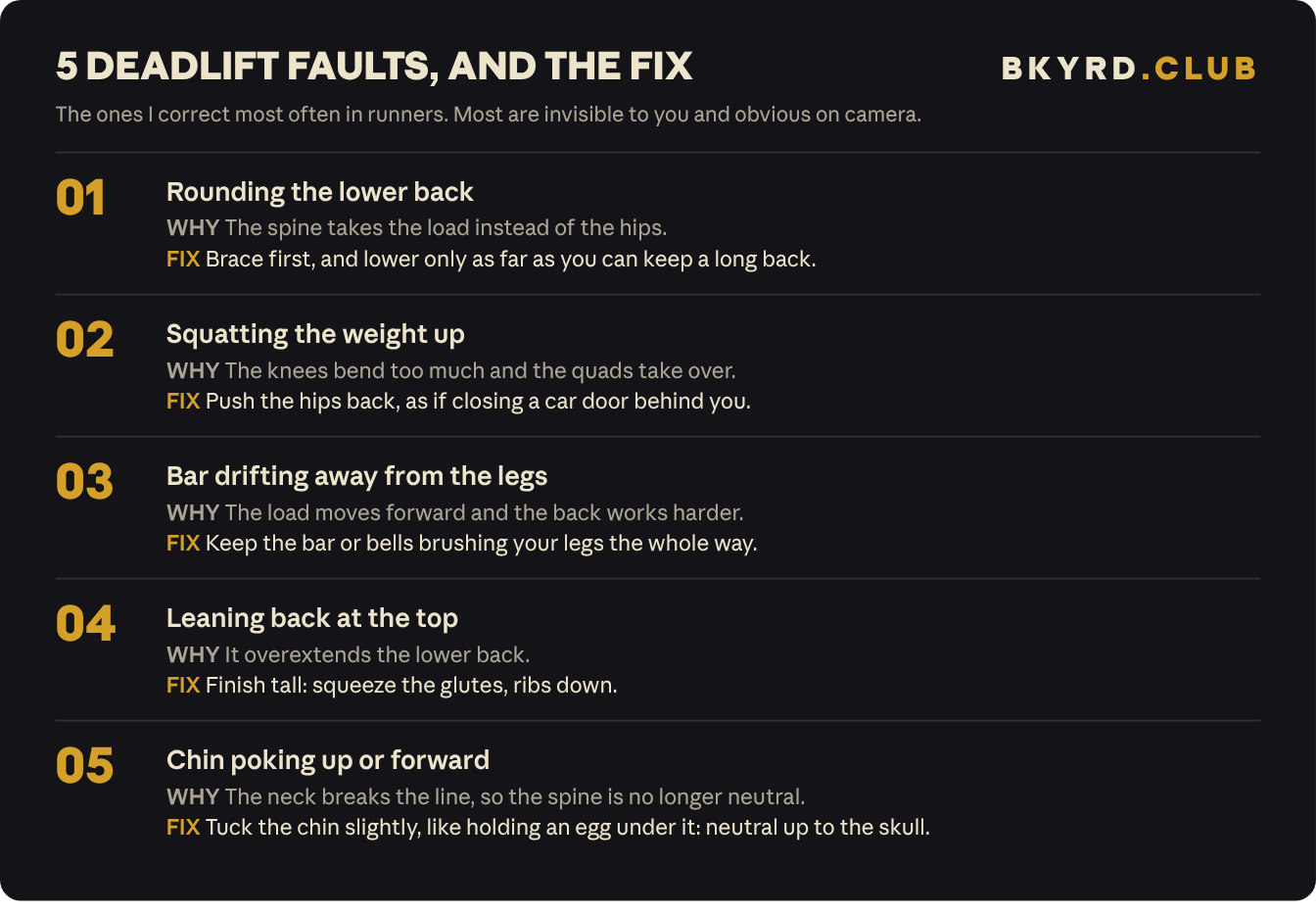
This is also why video matters. Most of these faults are invisible to the athlete and obvious on camera.
Where strength fits in your week
Two solid sessions a week is the golden ticket. Three works if you can recover well from them, but most runners get more from two done properly than three done tired.
The best place for them is as a second session on your hardest run days, not on your easy days. It sounds backwards, but it keeps your hard days hard and your easy days truly easy, so you recover between them.
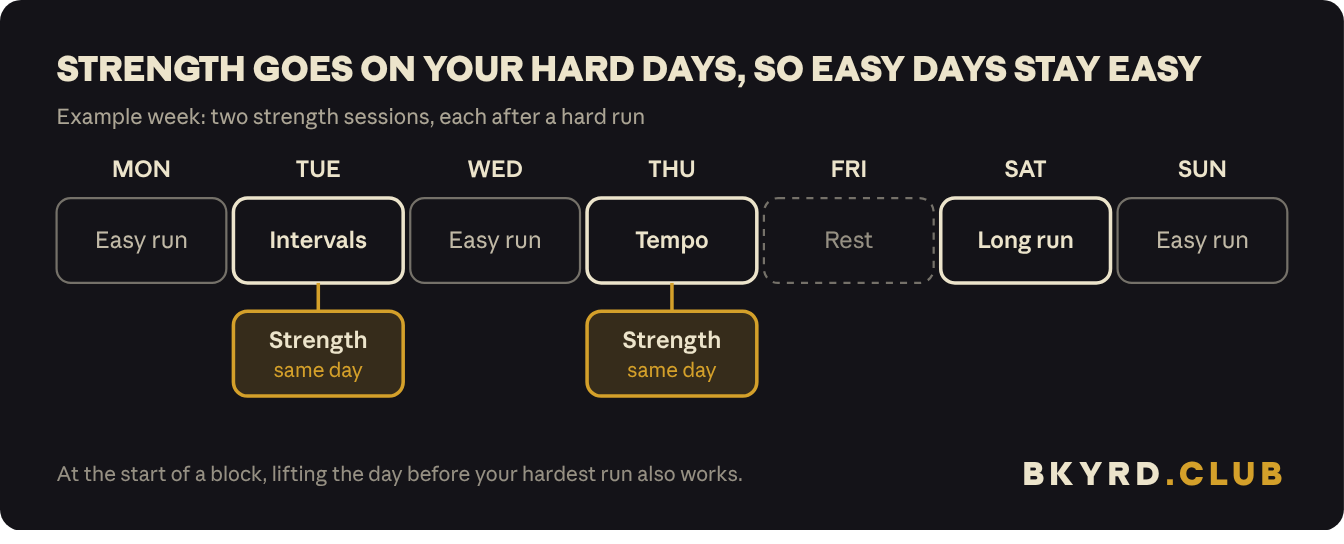
In a perfect world, at the start of a new block, you can also lift the day before your hardest run, while your legs are fresh for the heavier work.
What a block looks like
A block should not last more than 3–4 weeks. Four 3-week blocks make a 12-week cycle. Here's what that looks like for a main lift like the trap-bar deadlift or the box squat:
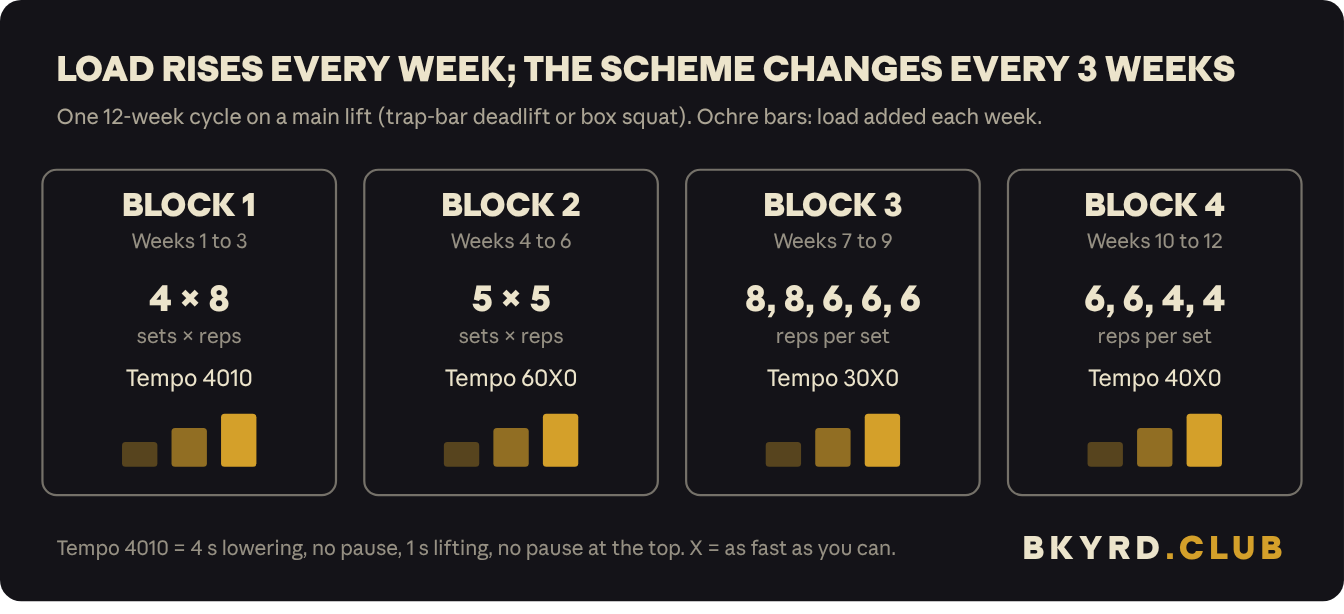
Inside each block, you add load every week, so week 3 carries the most. Then the next block changes the sets, reps and tempo, and you build again from there.
This structure alternates a higher-volume block (more reps, lighter loads) with a higher-intensity block (fewer reps, heavier loads). Blocks 1 and 3 above are the volume blocks, blocks 2 and 4 the intensity blocks, and each pair starts a little heavier than the last. KILO Strength Society builds its programs the same way: a 12-week macrocycle made of four 3-week mesocycles, two for accumulation and two for intensification [5].
The tempo is the four numbers: seconds lowering, pause at the bottom, seconds lifting, pause at the top. An X means lift as fast as you can. Controlling the lowering is where much of the tendon and muscle resilience comes from, and the fast lift is what carries over to your stride.
From one block to the next, the emphasis changes too. That's what keeps you adapting instead of plateauing:
Eccentric phase: slow, controlled lowering. Builds tendon and muscle resilience for the pounding of running.
Concentric phase: heavy, intent-driven lifting up. Builds raw force.
Dynamic phase: lighter loads moved fast. Turns that force into speed off the ground.
Alongside the main lift, the reps change and the accessory and remedial exercises rotate, so the program stays fresh without losing focus. Each block starts where the last one left you.
If you take three things from this: fewer exercises, heavier over time, and follow the block. Two sessions a week is the golden ticket; three is fine if you recover well from them.
If you'd rather not guess at the details, that's what a BKYRD strength program is for. It starts with a 75-minute movement assessment ($120, $100 for BKYRD members), where we film and correct your main lifts, then builds a 6, 12 or 16-week program around your running. Details and prices are on the Services & Pricing page.
Effort is a choice. Make it count.
Sources
Støren Ø, Helgerud J, Støa EM, Hoff J. Maximal strength training improves running economy in distance runners. Medicine & Science in Sports & Exercise, 2008.
Llanos-Lagos C, Ramirez-Campillo R, Moran J, Sáez de Villarreal E. The effect of strength training methods on middle-distance and long-distance runners' athletic performance: a systematic review with meta-analysis. Sports Medicine, 2024.
Lauersen JB, Bertelsen DM, Andersen LB. The effectiveness of exercise interventions to prevent sports injuries: a systematic review and meta-analysis of randomised controlled trials. British Journal of Sports Medicine, 2014.
Rønnestad BR, Mujika I. Optimizing strength training for running and cycling endurance performance: a review. Scandinavian Journal of Medicine & Science in Sports, 2013.
KILO Strength Society. Principles of periodization: the foundation of long-term progress. Inside the System, 2025.